
NEWS

BOS Gen found in a boy and ExAC

Again the recent publication by Urreizti et al. shows that pathogenic gene variants are part in a reference database should be taken into account. In order to assess genetic variants, reference population databases such as the Exome Aggregation Consortium (ExAC) database are part of researches. It is assumed that in this population database pathogenic gene…

Read More

Pulmonary hypertension

A new case report at Kagoshima City Hospital, Kagoshima, Japan describes in a newborn with Bohring-Opitz Syndrome Pulmonary Hypertension (PH). Children with Pulmonary (= lungs) hypertension (= high blood pressure) have small passageways,  blood vessels, in the lungs and because these passageways are so narrow, there is a very high blood pressure in the pulmonary…

Read More

Maternal Mosaicism

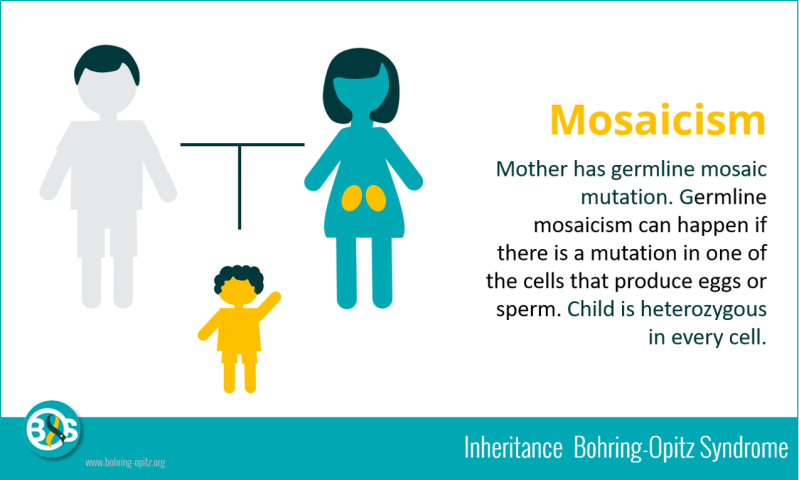
This new article by Emma Bedoukian and collegues present the first report of germline inheritance of Bohring-Opitz Syndrome. “[…] Most patients [affected with Bohring-Opitz Syndrome (BOS)] […] have a de novo nonsense or frameshift variant in ASXL1. We report a case of BOS caused by a pathogenic ASXL1 variant inherited from a germline mosaic mother.…

Read More

Research for ASXL Syndromes

We are thrilled to announce the launch of the ASXL Rare Research Endowment (AЯRE) Foundation (www.arrefoundation.org)! AЯRE will provide sustainable support for evidence-based research that will increase our understanding of the ASXL genes and improve the treatment of individuals with congenital ASXL mutations. Our ASXL families — who have Bohring-Opitz Syndrome (ASXL1), Bainbridge-Ropers Syndrome (ASXL3),…

Read More

Bohring-Opitz Syndrome

Bianca Russell, Wen-Hann Tan and John M Graham have published a new comprehensive overview about Bohring-Opitz Syndrome (BOS) in GeneReviews. After the publication of the Unique leaflet by Joanna Kennedy (2017), the “Clinical management of patients with ASXL1 mutation and Bohring-Opitz Syndrome […]” by Bianca Russell and colleagues (2015) and previously published article about BOS…

Read More

Germline mutation but no BOS

We have learned that  germline mutations of human ASXL1 is the cause of Bohring-Opitz  syndrome (BOS). Germline means its a novo ASXL1 mutation, the gene mutates at conception, creating a developmental disorder that leads to BOS. Patients with somatic ASXL1 mutation (the mutation formed during later life) have an increased risk of myelodysplasia (MDS), myeloproliferative…

Read More

News from the ASXL Registry

Exciting news from the ASXL Registry! Out of 33 families who have completed the  enrolment, 15 surveys are completed! To obtain accurate knowledge about causes, symptoms, quality of life and treatments for Bohring-Opitz Syndrome, it is important that more families enrol the ASXL Registry and we need your support. A well run registry helps produce…

Read More