
NEWS

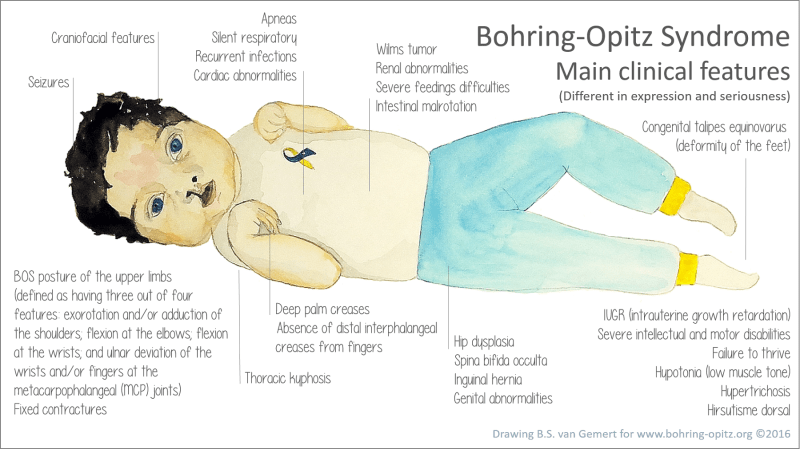
Main features of Bohring-Opitz Syndrome

Each child with Bohring-Opitz Syndrome is affected differently, but the physical appearance of children with Bohring-Opitz Syndrome is often alike and the clinical phenotype at birth is extremely similar. Not everyone will have all of these certain physical characteristics, but they may include features as described in these “Clinical Feature Cards” with the main features of Bohring-Opitz…

Read More

The Importance of a Bohring-Opitz Syndrome Patient Registry

For patients, caregivers and medical professionals there is still inadequate knowledge and resources about causes, symptoms, quality of life and treatments for Bohring-Opitz Syndrome (BOS). A patient registry (PR) for collecting information about this rare condition is an opportunity to increase the knowledge about Bohring-Opitz Syndrome. The BOS Foundation has started to work together with…

Read More

Do you know that …?

#BOSFACT – 29 facts about Bohring-Opitz Syndrome from Bohring Opitz on Vimeo. 29 February 2016 marks the ninth international Rare Disease Day coordinated by EURORDIS. This year the theme is: PATIENT VOICE! Bohring-Opitz Syndrome (BOS) is a rare disease and we want to invite you to learn more about BOS. In February 2016 we presented 29 days,…

Read More

How Hazel is helping science: Using Face2Gene

Originally posted on Tiny and Fierce: Living with Bohring-Opitz Syndrome:
Hazel – Newborn After we received our diagnosis of a rare disorder called Bohring-Opitz Syndrome, I wanted to know how we could help others receive an accurate diagnosis faster and more easily than we did. A few months before Hazel’s diagnosis, I learned about a…

Read More

Give a Face to a Syndrome

We, the Bohring-Opitz Syndrome Support Group, are supporting the FDNA (Facial Dysmorphology Novel Analysis) project ‘Face2Gene’. Bohring-Opitz Syndrome (BOS), which has with less than 60 children recognized in medical history, is a very rare genetic disorder and knowledge of BOS is still in its early stages. By supporting the groundbreaking Face2Gene project we want to be at the forefront of…

Read More

Growth Charts for children with BOS

Growth in children with Bohring-Opitz Syndrome (BOS) is different from healthy children.  Children with BOS are characterized with IUGR (Intrauterine Growth Retardation) and severe feedings problems, as well as failure to thrive. With this in mind, we think it is important to take a different view on the growth of children with BOS.  We gave parents and…

Read More